
Fixed Index Annuity
A fixed index annuity is a tax-deferred insurance product that provides market upside while protecting principal from market losses.
Fixed Index Annuity (FIA)
Client Profile: Conservative
Protection Level: High
Funding Source: Fixed Income
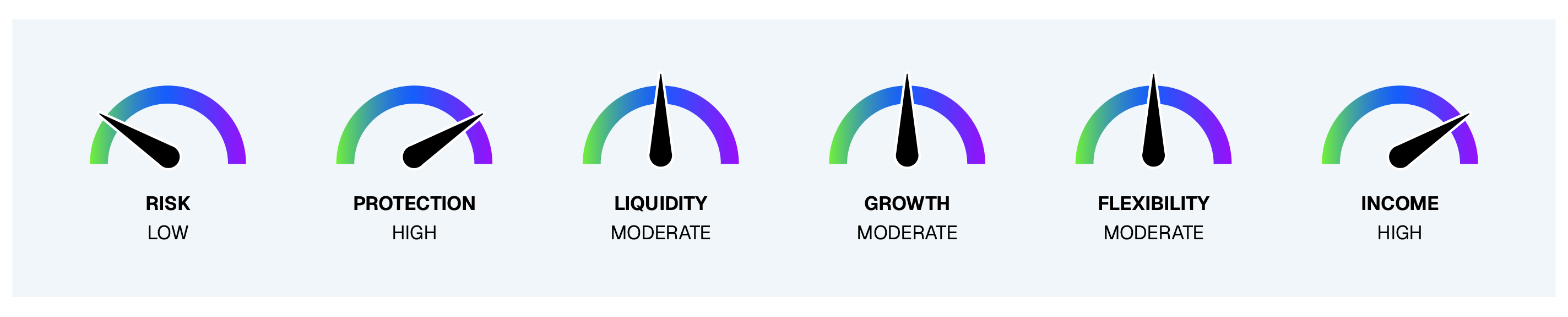
Evaluate index-based annuities through a fiduciary lens to balance growth, protection, and income, using fixed index annuities to deliver market-linked returns with principal protection and controlled risk for long-term planning.
Fixed Index Annuities
An index-linked annuity combines elements of accumulation and protection, making it a flexible tool for advisors managing risk-adjusted portfolio outcomes.
- FIAs are typically used for clients seeking growth potential with downside protection, without full equity exposure.
- Provides principal protection through a 0% floor, ensuring contract value is not reduced by market declines.
- Often used as a complement to bonds or as part of a diversified retirement income strategy.
What Is a Fixed Index Annuity and Where Does It Fit?
A fixed index annuity is an insurance-based product that credits interest based on the performance of a market index, such as the S&P 500, while protecting against losses.
For advisors, the FIA annuity is commonly positioned for:
- Situations where sequence-of-returns risk is a concern
- Retirement strategies balancing income and accumulation
- Portfolios requiring reduced volatility
- Clients seeking principal protection with growth potential
Unlike direct equity exposure, returns are determined using predefined formulas, making outcomes more predictable within a controlled range. This makes the index-linked annuity a useful tool for advisors' balancing growth and capital preservation.
How Does a Fixed Index Annuity Work?
- A client allocates a lump sum into the annuity contract
- Growth accumulates on a tax-deferred basis
- If the index declines, the contract applies a 0% floor
- Interest is credited based on participation rates, caps, or spreads
- The insurer tracks the performance of a selected index
- A client allocates a lump sum into the annuity contract
Because of this structure, a fixed annuity index approach allows participation in market upside without exposing principal to market losses. This structure defines how an index-linked annuity delivers returns within controlled parameters.
Key Features of a Fixed Index Annuity
An indexed annuity is defined by several structural features that determine how returns are generated:
- Optional income riders for lifetime income
- Tax-deferred growth
- Spread-based crediting structures
- Cap rates limiting maximum returns
- Participation rates determining exposure to index gains
- Index-linked interest crediting
- Principal protection against market losses
These features define how an index-based annuity balances growth potential with risk control.
Rates, Returns & Income
How Fixed Index Annuity Rates Work
Returns within an index-based annuity are not fixed in the traditional sense. Instead, the annuity generates returns based on index performance and the crediting method applied.
Advisors should evaluate:
- Participation rates
- Cap levels
- Spread deductions
- Crediting periods
These variables determine how much of the index return is ultimately credited to the contract. Understanding how an indexed annuity calculates returns is essential for setting realistic expectations.
What Impacts Fixed Index Annuity Rates:
- Insurer hedging strategies
- Product structure and rider selection
- Length of surrender period
- Market volatility and interest rate environment
Because these factors change over time, evaluating index-based annuity rates requires ongoing comparison across carriers.
Why Comparing FIAs Matters
Not all FIAs are structured the same. Differences in caps, spreads, and participation rates can significantly impact outcomes.
Using a centralized comparison approach helps:
- Reduce reliance on carrier-specific assumptions
- Align product selection with client goals
- Improve transparency
Types of Fixed Index Annuities
There are several variations of the index-based annuity, each designed to meet different planning needs:
- Deferred FIAs - Focus on accumulation before income conversion
- Income-Focused FIAs - Include guaranteed income riders
- Multi-Index FIAs - Allow allocation across different indices
- Strategy-Driven FIAs - Offer multiple crediting methods
Each type balances growth, income, and flexibility differently.
Benefits & Tradeoffs
Let's explorer the pros and cons of fixed indexed annuities.
Benefits
- Reduced portfolio volatility
- Income planning flexibility
- Tax-deferred growth
- Potential for higher returns than traditional fixed products
- Downside protection through principal guarantees
Tradeoffs
- Fees associated with riders
- Surrender periods and liquidity constraints
- Product complexity
- Limited upside due to caps and participation rates
These factors should be evaluated carefully when determining whether an index-based annuity is appropriate for a client.
How Advisors Use Fixed Index Annuities
Advisors use indexed annuities in several strategic ways within client portfolios:
Equity Risk Management
FIAs can reduce exposure to market downturns while maintaining some growth potential.
Income Generation
Income riders allow conversion into predictable lifetime income streams.
Portfolio Diversification
FIAs provide an alternative to traditional fixed income allocations.
Retirement Planning
They can serve as a bridge between accumulation and income phases.
Applying FIAs in Practice
Advisors should evaluate:
- Cost structure and rider impact
- Role within the broader portfolio
- Time horizon and liquidity needs
- Client risk tolerance
For example, FIAs may be used to protect a portion of assets while allowing the remainder of the portfolio to pursue higher risk strategies. In this context, the fixed index annuity serves as a bridge between growth and protection.
Fixed Index Annuity vs. Other Income Solutions
This comparison highlights where a fixed index annuity fits within the broader landscape of income solutions.
Advisor Considerations for Fixed Index Annuities
When evaluating a fixed index annuity, advisors should consider:
- Integration with broader planning strategies
- Insurer strength and creditworthiness
- Surrender schedules and liquidity constraints
- Fee structures, including fixed index annuity fees
- Alignment with client objectives
A properly structured fixed index annuity should align with both portfolio strategy and client expectations.
FIAs may also complement broader financial planning approaches, including life insurance strategies.
Evaluate Fixed Index Annuity Strategies
Advisors can access tools and resources to evaluate FIA structures, compare product features, and align annuity strategies with client portfolios.
Explore fixed index annuity options and rates
Compare annuity products across carriers
Schedule a demo to review platform capabilities
Support & Tools
Advisors can leverage platform tools to:
- Support client decision-making
- Model income scenarios
- Evaluate crediting strategies
- Compare FIA products across carriers
Key Takeaways
- A fixed index annuity should be evaluated within overall portfolio strategy
- Product comparison is essential for optimal selection
- A fixed index annuity can support income planning and risk management
- Returns are tied to index performance but limited by structured parameters
- A fixed index annuity offers a balance of growth and protection
Frequently Asked Questions About Fixed Index Annuities
What is a fixed index annuity?
An indexed annuity is an insurance product that provides index-linked returns with principal protection.
How does a fixed index annuity work?
Returns are credited based on index performance using caps, participation rates, or spreads.
What are the fees associated with FIAs?
Base contracts may not include fees, but optional riders can add costs.
Are FIAs suitable for all clients?
They are generally suited for conservative or income-focused investors but depend on individual goals.
What is the best indexed annuity?
The best option varies based on structure, rates, and client needs.
Disclosures:
FIAs may be subject to surrender charges, market value adjustment, and taxation for early withdrawals.
Fixed index annuities are contracts purchased from a life insurance company that are designed for long-term retirement goals.
While the interest rate credited to an indexed account is linked to the performance of an underlying index, premium payments made to a fixed index annuity are never directly invested in the stock market.
All guarantees are based on the financial strength and claims-paying ability of the issuing insurance company.
The purchase of an annuity within a retirement plan that already provides tax deferral under sections of the Internal Revenue Code results in no additional tax benefits. An annuity should be used to fund a qualified plan based upon the annuity’s features other than tax deferral. All annuity features, risks, limitations, and costs should be considered prior to recommending the purchase of an annuity within a tax-qualified retirement plan.
Contact Us
Have more questions about our insurance offering? Call us at 888.327.0049 to speak to a DPL Consultant.